Perspectives
When Space Becomes Part of the Technology

Vi - Visual Illusions
Insights
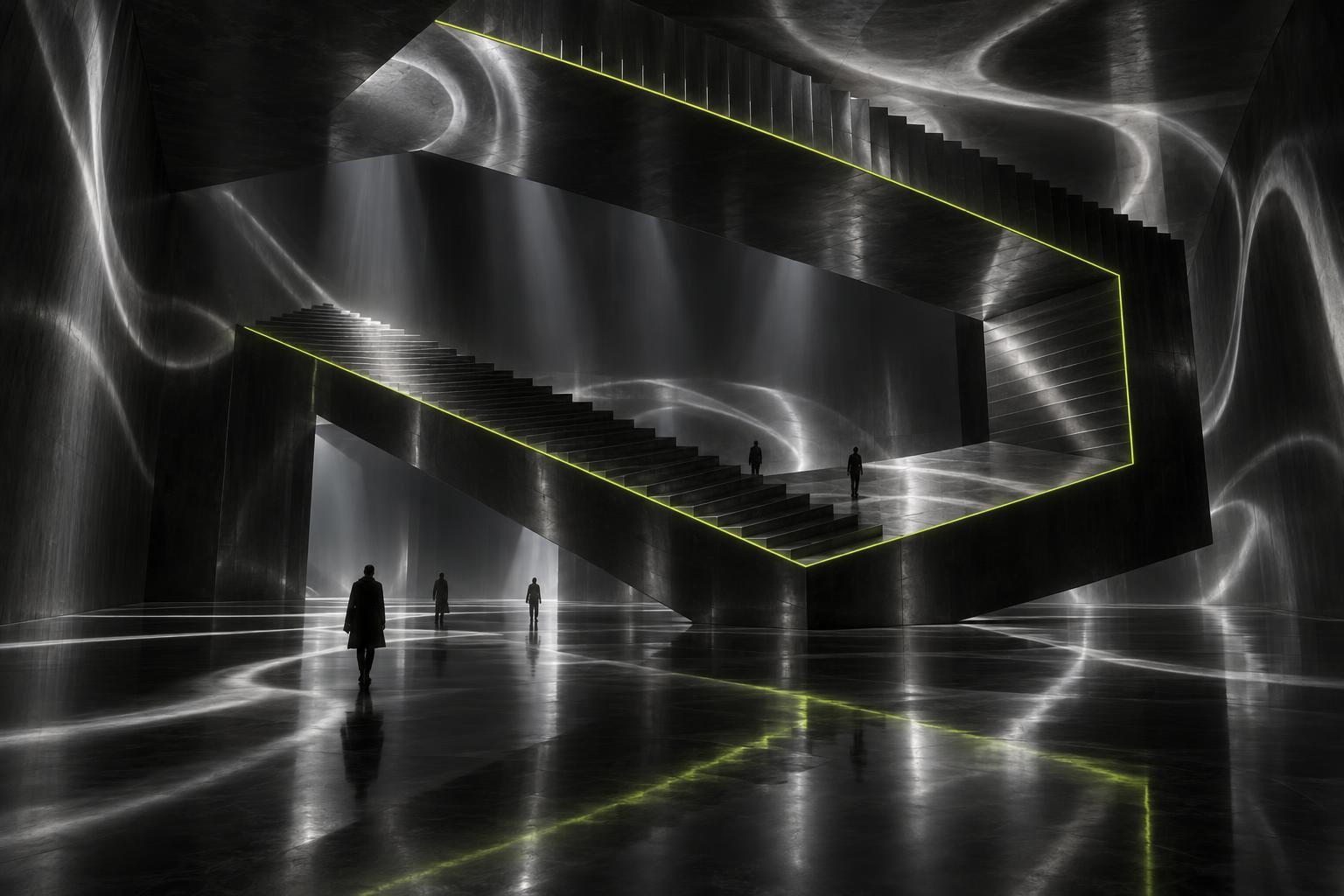
Screens are larger than ever, sensors understand movement, 3D engines build worlds in real time and AI can interpret what happens in a room. Yet most venues, stages and physical surfaces still work as passive containers. Teams bring the technology in, switch it on and point it at the audience. At Vi – Visual Illusions we start from a different question. What if the space itself became part of the technology, so that every immersive experience begins with the room rather than with the screen?
A space that sees people, responds to their movement and changes the image, sound and light around them is no longer a backdrop. Instead, it becomes the medium. This article looks at what that shift involves, the techniques that make it possible, and how we design an immersive experience around a space instead of simply placing one inside it.
From passive container to responsive environment
A stage remains a stage. A hall remains a hall. A building facade remains a static surface. That has been the default for decades, and it shapes how most events and attractions get planned. First someone produces content for a screen, then a crew installs the screen in a room, and the room itself plays no part in the immersive experience.
The opportunity we see is to reverse that order. When surfaces, sound, light and interaction work together from the start, a venue can move along five lines:
Static surfaces become adaptive visual environments.
Passive audiences become interactive participants.
Separate technical systems become integrated show control.
Generic venues become transformable experiences.
Imported know-how becomes Saudi capability and, in time, technology creation.
None of this depends on a single device. Rather, it depends on treating the room as one connected system. That is the point where an immersive experience stops being a show in a space and becomes the space itself.
Four ways a space starts to respond
The techniques behind responsive space are well established around the world, and strong immersive experience design usually combines several of them. The credited studios executed the reference projects below; VI did not. We cite them because they show, very concretely, what each technique can do.
Surfaces that become media
Projection mapping turns architecture into a canvas by fitting content precisely to the geometry of a building or object. At Roshen Plaza in Kyiv, for example, Front Pictures created a permanent projection-mapping landmark across a 100-meter reconstructed factory facade. Its multiple shows grew from the concept of a giant city clock. Similarly, at the Melody Maker hotel in Cancun, Front Pictures covered a 7,000-square-meter facade with 16 high-output projectors. As a result, the facade operates as an attraction throughout the year.
At this scale the facade stops being a backdrop. It becomes the stage on which the whole immersive experience takes place.
Floors and walls that follow people
Tracking is what makes a projected room feel alive rather than simply lit. For Utopia, executed by THEORIZ at the Royal Museums of Art and History in Brussels, eight projectors and Augmenta tracking extended an interactive world across a 20 x 10 meter floor and five-meter-high walls. Visitors’ movement became part of the artwork. Meanwhile, in Pont-de-Claix, France, THEORIZ used six 4K projectors, LiDAR and 5.1 spatialized sound in the Cosmocité immersive room. There, a 12 x 6 meter floor supports several interactive formats, including collaborative games.
In both cases the people inside the room shape the immersive experience; nobody simply plays it at them. That is the difference between a room that is projected and a room that responds.
Rooms where the experience becomes fully immersive
When projection covers walls, ceiling and floor, the audience stops looking at an image and starts standing inside one. Explore Vatican, executed by Front Pictures in Los Angeles, used 36 projectors to surround visitors with a 360-degree journey through Vatican art and architecture. At a far smaller scale, the KOSMO mobile room by THEORIZ fits 360-degree projection and interaction into a 6 x 6 meter space designed for rapid installation. It is a useful model for touring formats, where an immersive experience has to travel.
Objects and audiences that steer the scene
Sometimes the most powerful interface is a person. For Adobe Summit EMEA 2018 in London, Cinimod Studio created a six-meter projection-mapped globe. Its visuals responded to delegates’ facial expressions, lanyard scans and touch, in sync with the floor, light rods and surrounding screens. Earlier, Cinimod Studio’s Mood Conductor let participants use gesture and heart-rate input to set the lighting mood of the London Eye during the 2012 Olympic period. In other words, one participant could steer a city-scale landmark with nothing but human signals.
Designing an immersive experience as one system
What these references share is not a particular projector or sensor. It is integration: every layer, from concept and content to software, hardware and live operation, serves the same story. That is how we approach every immersive experience, and it starts with people rather than equipment.
Imagine the experience. What should people see, feel, hear and do inside the space? The answer defines everything that follows.
Design the ecosystem. We design creative direction, visual content, interaction, sound, lighting, software and hardware as one connected system.
Integrate, produce and control. We coordinate content, equipment, programming, installation and live show control to deliver a synchronized audience experience.
However, the control layer is where many projects break down. Media servers, timecode synchronization and DMX, Art-Net and OSC connectivity let image, sound, light and movement run as a single sequence. Without them, each department runs its own clock. When that layer is part of the plan from the first sketch, an immersive experience can change with the artist, the audience or the moment without losing its timing.
Riyadh has already seen what this level of integration looks like. The opening show of the Global AI Summit 2022, executed by Front Pictures and the Antigravity Show team, combined two LED screens on robotic arms, projection mapping, lasers, 7.1 sound and a 23-meter LED wall. Show control held every element to one timeline. It is a clear benchmark for the kind of work we are building the capability to integrate and deliver in the Kingdom.
Where an immersive experience matters most
A space that responds is not a niche idea. It applies wherever the quality of a visit decides whether people remember it:
Major events and entertainment
Brands, exhibitions and product launches
Culture, museums and tourism
Government and national events
Real estate, hospitality and destinations
Sports, esports and fan experiences
Each sector asks something different of the room. A museum needs an immersive experience that supports learning without losing spectacle. A product launch may need a physical object that controls a digital world around it. A fan zone, by contrast, needs thousands of people to feel part of one moment. Still, the approach stays the same: start with the person, then build the system around them.
From temporary installations to permanent platforms
Temporary projects give us a stage for execution. Responsive space, however, improves fastest when teams can test, rehearse and refine it continuously. That is the thinking behind VI – Events Arena, a proposed 10,000–15,000 capacity destination in Riyadh. As a concept, it would host events and also work as a venue, laboratory, showroom, production center and training facility. Its planned VI Experience Lab would let designers, engineers, developers and show technicians test interaction systems and new display concepts before any of them becomes part of an immersive experience for the public.
Further ahead, our research direction takes the idea to its limit. Digital Optical Skin (DOS) is a future R&D platform, a concept under development, that explores making the physical surface itself part of the digital system. If a room can respond to people, the long-term question is whether a wall, a ceiling or a facade can become an adaptive visual layer in its own right.
Start with the space, not the screen
Whether you are planning a major event, a destination, an exhibition or a brand experience, the first conversation should be about the space and the people in it. Explore our services to see how immersive environments, live show technology, real-time content and show control fit together. Then browse the reference projects that show what an immersive experience can become, and contact us to start shaping yours.