Perspectives
Beyond the Screen: The Future of Adaptive Visual Reality

Vi - Visual Illusions
Insights
For decades, progress in display technology has been measured in size and sharpness: bigger screens, more pixels, brighter panels. Yet however far resolution advances, a screen remains a separate surface that shows content in front of the viewer. Meanwhile, the world around us is changing digitally at enormous speed, while its visual form stays largely static. A building remains a building, and a wall remains a wall. At Vi – Visual Illusions, we believe the next step is not a better rectangle. Instead, it is an adaptive visual reality, in which the physical surface itself becomes part of the digital system.
The limits of today’s display technology
The visual tools we use today are powerful. Still, each of their main forms solves only one part of the problem:
LED screens, the most familiar display technology, show content on a surface.
Projection mapping changes the appearance of a surface, but only under specific conditions such as controlled light and a known geometry.
AR and VR add digital worlds, but usually through a device or headset that sits between the viewer and the world.
In other words, none of them makes the surface aware of its surroundings. The panel does not know what is behind it, who is looking at it or from where. That gap is exactly where the next generation of display technology becomes interesting.
How display technology is already moving beyond the screen
Some of the most striking work of recent years shows the boundary of the screen starting to give way. The credited studios executed the reference projects below; VI did not. Each one, however, shows a different route out of the frame.
Perspective that breaks the frame
Anamorphic 3D content is designed for specific viewing positions, so objects appear to burst out of a flat display. For example, BCN Visuals created 3D out-of-home content for the PlayStation Marvel’s Spider-Man 2 campaign on exactly this principle. Similarly, its Meta Quest 3 campaign was designed to make outdoor media behave like a window into another dimension. In both cases the display technology is a conventional large-format digital screen. The illusion comes from content built around the viewer’s eye.
Holographic and volumetric display technology
Holographic displays remove the visible frame altogether. For the Nike Air Max Dn launch in Paris, HYPERVSN surrounded customers with 3D product views that explained the shoe’s internal technology. Likewise, in Milan, HYPERVSN turned a HUGO shop window into a gesture-controlled holographic experience that passersby could change with a movement of the hand.
Volumetric display technology goes a step further. It shows illuminated three-dimensional objects within a defined physical volume, so viewers can see them from several directions.
Architecture as the canvas
At landmark scale, the building itself becomes the medium. AI DATAPORTAL, executed by Ouchhh in collaboration with Reasoned Art and project partners, mapped a generative artwork built from Italian cultural data around Milan’s Arco della Pace. In the same spirit, for Apple TV’s Formula 1 campaign, BCN Visuals designed content for the Las Vegas Sphere, treating its curved surface as a cinematic object rather than a billboard.
All of these approaches share one dependency. They are designed for a known geometry and known viewing positions, so the surface itself still does not understand its surroundings. Display technology that can sense and respond to its environment is therefore the step that remains.
What adaptive visual reality means
Adaptive visual reality is the idea that a surface can understand the environment around it, respond to it and change what people see in the real world. Rather than showing content in front of the viewer, the surface becomes part of the scene. In that sense, it is less a new kind of display technology than a new role for the surface itself.
Several technologies make the idea worth pursuing now:
Displays are becoming thinner and more flexible.
Cameras and sensors are getting smaller and faster.
AI is more capable of understanding and reconstructing scenes.
GPUs are powerful enough for complex real-time rendering.
Edge computing and XR systems are maturing.
Each of these matters on its own. The opportunity we see, however, lies in bringing them together within one visual system, where display technology, sensing and computation behave as a single layer.
Digital Optical Skin (DOS): our research direction
Digital Optical Skin (DOS) is our future R&D platform: a concept under development for an intelligent visual layer between the physical world and digital reality. It is not a finished product, and it is not a new screen. Rather, it is a different way of thinking about display technology.
The concept combines digital display layers, micro cameras, depth sensors, real-time processing, artificial intelligence, perspective correction and 3D engines. The goal is to reconstruct the environment around a surface, so that the object can visually blend with its surroundings from designed viewing zones. Later, the same system could replace or combine that reconstructed scene with new digital content.
How the concept is intended to work
Environment capture. Cameras and depth sensors capture the surrounding scene, lighting, depth and motion.
Intelligent processing. The DOS AI Engine analyzes the scene, corrects perspective and distortion, and generates the required view for the target viewing zone.
Real-time reconstruction. The system synchronizes the visual output across the surface, so it can reproduce the environment behind the object.
Reality extension. Once the surface is visually controllable, 3D objects, effects, information and new environments can join the reconstructed scene.
The envisioned system layers include a future flexible display layer, a camera and sensor network, the DOS AI Engine, perspective correction and tracking, real-time rendering, and edge computing and synchronization. In addition, optional future power-support concepts, such as integrated solar layers, are part of the vision.
Starting with one measurable proof
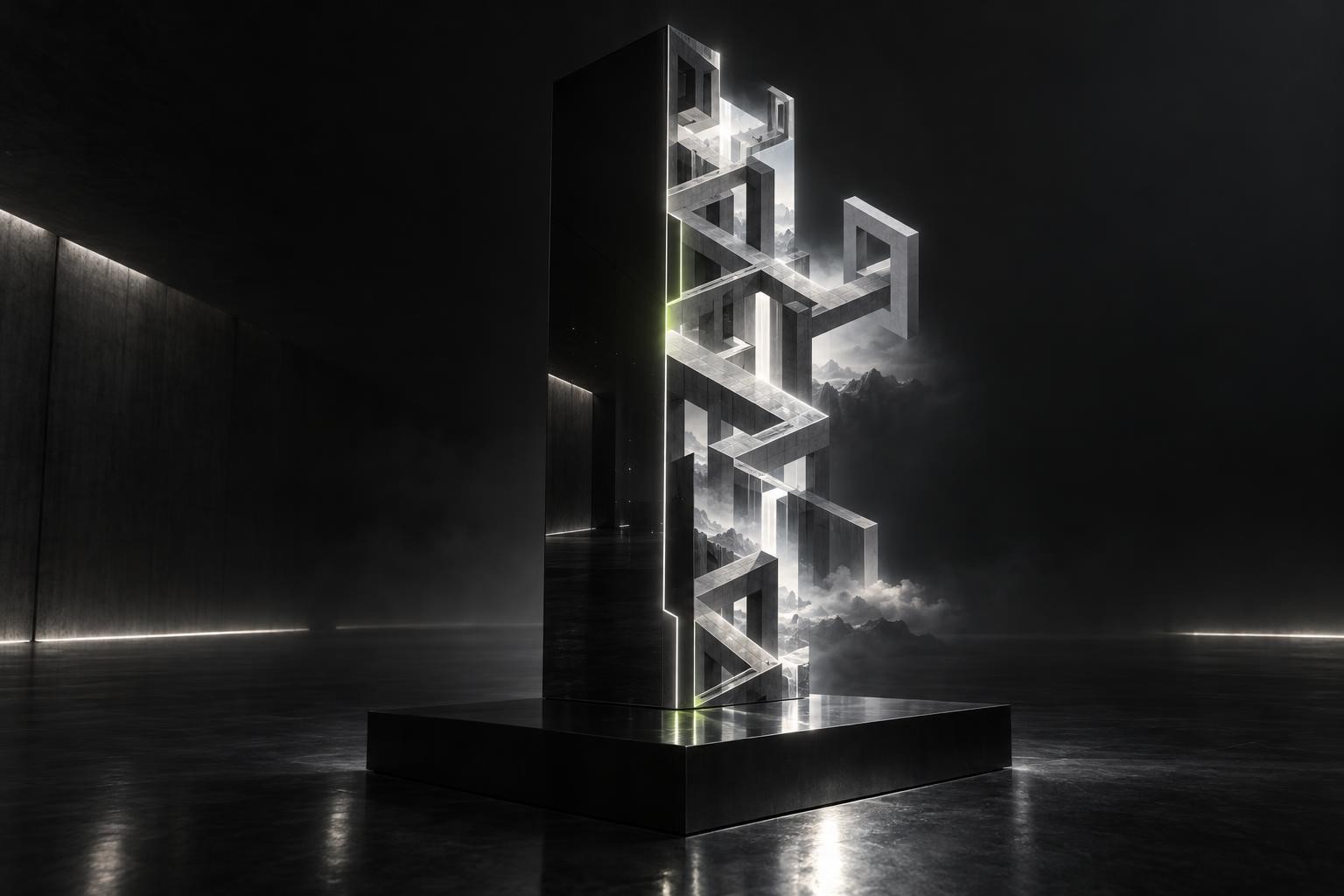
We do not plan to begin by covering a tower. Instead, the first step is the DOS Mini Tower, a planned architectural demonstrator approximately 1.5 meters high. It would combine high-resolution displays, cameras, sensors, real-time processing and live rendering. The prototype is intended to demonstrate three stages: the normal object, visual blending with the environment, and the transformation of the resulting visual space into a digital environment with 3D content.
After that, the roadmap moves step by step:
Prototype demonstrator. Build and test the DOS Mini Tower.
Architectural pilot. Move to a limited-scale real facade or architectural installation.
Vehicle prototype. Test a moving platform and transportation applications.
Commercial smart cities. Explore larger-scale commercial infrastructure and smart-city partnerships.
Where adaptive display technology could matter
If the research succeeds, the applications could reach well beyond events and advertising. Potential future applications include:
Architecture and landmarks
Aviation interiors
Transportation
Automotive surfaces
Hotels, homes and luxury spaces
Advertising and large-scale media
Smart-city infrastructure
Remote visual environments
Imagine an aircraft ceiling becoming an extension of the sky outside, or a facade that shifts between its real surroundings and a new digital scene. To be clear, these are directions for long-term R&D, not performance we claim today. They build on the display technology in our current execution focus: immersive spaces, projection mapping, holographic and volumetric displays, and real-time graphics.
A wall may no longer be just a wall
The phone, the car and the home have all become smart, and cities are following. The surfaces that shape our world, however, remain largely static. In the future, a ceiling may no longer be just a ceiling, and a facade may no longer be just a facade. DOS is a long-term R&D platform aimed at changing the relationship between the physical surface and the digital world, and we are building toward it one proof at a time.
To follow the research, visit the DOS page. To see how today’s display technology comes together in immersive environments, explore our services and the reference projects. For technology and R&D partnerships, contact us.